
The Textbook
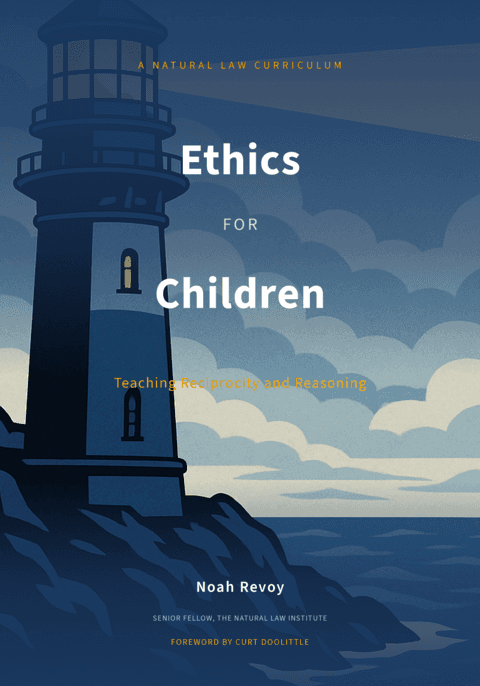
Ethics for Children
A Natural Law Curriculum for Teaching Reciprocity and Reasoning
by Noah Revoy · Foreword by the founder of The Natural Law Institute
A textbook that teaches children to reason ethically: not through stories, not through ideology, but through a method they can test, apply, and defend on their own.
You already see the problem. Your students can recite slogans about kindness and inclusion, but when a genuine moral question lands on the table, they have nothing to reason with. They have feelings. They have opinions borrowed from adults who borrowed them from institutions. What they do not have is a method.
The ethics curricula available to you fall into three categories, and all three fail. Ideological curricula train allegiance to a narrative; the child learns what to conclude, not how to think. Character education offers virtues as a list to memorize, detached from any logic that could generate them. And moral relativism, the reigning default, teaches children that right and wrong are preferences, that every perspective carries equal weight, that moral judgment itself is suspect. The result is a generation equipped with sentiments but no grammar.
You feel the danger of this. You see it when a child cannot explain why lying is wrong except by appealing to an authority who said so. You see it when a bright student folds under peer pressure because she has no framework sturdy enough to stand on. You see it every time a moral conversation in your classroom dissolves into competing feelings with no way to adjudicate between them.
Imagine the board meeting six months from now. A parent has written in. She has read the curriculum your school adopted, and she is asking, in front of the entire board, why her daughter was taught that right and wrong depend on context. The head of school looks at the curriculum coordinator. The curriculum coordinator looks at the textbook. The textbook says, in so many words, that ethical reasoning is a form of perspective-taking. There is no first principle to point to. There is no defensible structure. The room is silent for the wrong number of seconds, and the head of school answers with a sentence that begins, “Well, what we try to do is…” That answer will be remembered. It will be repeated to other parents. It will appear, eventually, in a letter to the chair of the board. The cost of having no defensible ethical framework is not theoretical. It is a meeting on a Tuesday in November.
Imagine the IB authorization visit two years from now. The visiting team asks how the school evidences Criterion D, reflective thinking, principled action, ethical reasoning, across the MYP. The coordinator opens the binder. Inside the binder are stories the children read, projects the children completed, posters the children made. The visitor nods politely and writes a note. In the report, three weeks later, the school is asked to strengthen the explicit teaching of ethical reasoning frameworks. That report goes to the head of school, who forwards it to the board, who asks the coordinator how this happened given that the school has spent years on character education. The honest answer is that character education without a method is a feeling, and feelings do not survive an inspection. The school had nothing to point to because the curriculum had nothing to teach.
Imagine the kitchen table four years from now. A fourteen-year-old is asked, by a classmate or a coach or an aunt, why she believes what she believes about a moral question. She has been in your school since age six. She has done the projects, sung the songs, written the reflections. She opens her mouth, and what comes out is a phrase she heard from a teacher once, repeated as if it were her own thought. She cannot explain why it is true. She cannot defend it against the next sentence. She does not know what would have to be the case for it to be wrong. She is not stupid. She is not unprincipled. She has been given conclusions without a method, and a conclusion without a method is a flag in the wind. Her parents paid tuition for this. The school promised to form her. She walks out of the kitchen and the moment is gone, and so is the chance to have done it differently.
This book was written because that failure is not inevitable. It is the consequence of teaching ethics without a method. There is a method, and it has been available for a very long time. It does not require belief. It does not require obedience. It requires only reasoning, and children are remarkably good at reasoning when someone furnishes them the tools.
The Natural Law Method
Natural Law is not a philosophy to be adopted. It is a method to be applied. It rests on three principles that any child can learn, any teacher can teach, and no ideology can co-opt:
Testifiability. Can this claim be tested? Can it be observed, measured, or falsified? If a moral rule cannot survive scrutiny, it is not a rule; it is an opinion. Children learn to ask the question that dissolves every unfounded claim: “How would we test that?”
Operationality. Can this principle be stated in terms of observable actions? Not feelings, not intentions, not abstractions, but conduct that can be seen and evaluated. The child who learns operationality learns to cut through rhetoric and ask: “What exactly would that look like?”
Reciprocity. Does this action impose unconsented costs on others? Would I accept this treatment if our positions were reversed? Reciprocity is the bedrock of all cooperation, and cooperation is the foundation of civilization. A child who internalizes reciprocity possesses the most powerful tool for moral reasoning.
Together, these three principles form a grammar of ethics. They are not cultural. They are not religious. They are not political. They are universal because they describe the conditions under which cooperation is possible at all. A child who learns this grammar does not need to be told what is right. She can compute it.
What This Book Gives a Teacher
The first thing it gives you is a framework you can stand on. When a student asks why stealing is wrong, you will not need to appeal to tradition or authority or the discomfort of the class. You will have a method that generates the answer through reasoning the student can follow and verify. The authority rests in the logic, not in you, which means it cannot be undermined by the next adult who disagrees with you.
The second thing it gives you is immunity from ideological capture. This curriculum does not belong to a political camp. It cannot be claimed by the left or the right because it does not begin from conclusions; it begins from a method of testing conclusions. When a parent or administrator challenges your teaching, the method itself is your defense. You are not teaching children what to think. You are teaching them how to test.
The third thing it gives you is a 36-week plan. Six instructional blocks. Eighteen core lessons. Integrated assessments, classroom exercises, and a capstone project in which students draft their own classroom constitution, a governance document they construct from the principles they have learned. The curriculum is not a set of ideas to sprinkle into existing instruction. It is a complete course of study, sequenced, scaffolded, and ready to teach.
The book is written at a collegiate level for the instructor, because the method requires genuine understanding, not just transmission. The student-facing materials, available in the companion course, are written for children. The teacher masters the logic; the children learn the grammar. This is how every serious subject is taught.
Who This Book Is For
This book was written for teachers who are tired of teaching ethics as a list of sentiments. For educators in classical schools who want a curriculum grounded in reason rather than narrative. For homeschooling parents who refuse to choose between dogmatism and relativism. For anyone responsible for the moral formation of children who has looked at what is available and found it insufficient.
It was written for adults with the courage to teach children that moral truth is not a mystery to be believed but a computation to be performed. That rules are not arbitrary decrees handed down by authority but testable propositions that can be constructed, evaluated, and defended. That a child who can reason ethically is a child who cannot be manipulated ideologically.
The developmental window around age ten is a critical period in a child's capacity for moral abstraction. At this age, children transition from mimicking the moral behavior of adults to constructing their own moral reasoning. What they receive during this window determines whether they will become sovereign thinkers or compliant followers. The stakes are not abstract. They are sitting in your classroom, or at your kitchen table, right now.
From the Foreword
“What Noah has produced in Ethics for Children is not a simplified philosophy, but a faithful translation of first principles into the language of youth. It preserves the rigor of operational reasoning, reciprocity, and testifiability while making them performable: something a child can actually do, not merely believe.”
The Natural Law Institute
The Workbook
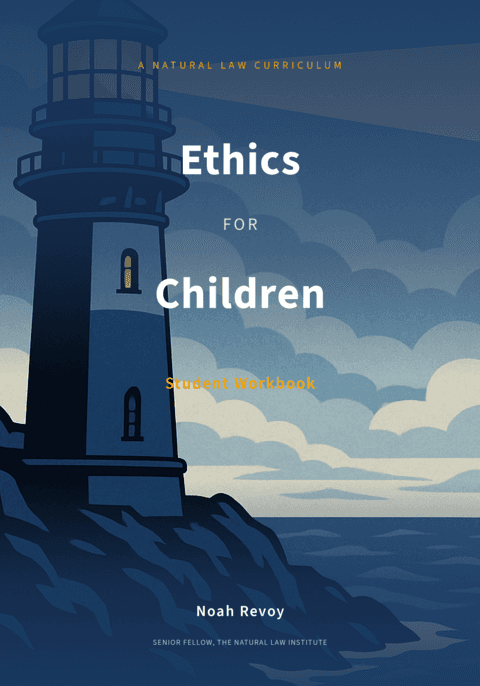
Ethics for Children: Student Workbook
Softcover, 232 pages, 7×10 trim
The student workbook is the child-facing companion to the teacher's textbook. Aligned chapter by chapter, it contains the exercises, reflective writing prompts, vocabulary activities, and assessment pages that students work through during each lesson. Designed for classroom use at the upper elementary level.
ISBN: 978-989-36612-1-5 · Published by Iron Crown Publishing
Get the Books
Order directly and we ship to your door. Free shipping included.
Published by Iron Crown Publishing
Already have the book? The teaching resources furnish every practical tool you need to teach it: rubrics, worksheets, parent letters, project templates, and implementation checklists.
View Teaching Packages